Spryker-Sylius reCommerce Business Case
02.2026

AXON21 GmbH
634358f, Wien, Austria
AXON21 OÜ
16304707, Tallinn, Estonia
02.2026
Client / Customer View
– Eliminated the platform’s annual license cost. This alone justified the effort of the reCommerce project.
– Seamless migration. Most customers haven’t noticed the change in underlying commerce platforms (from Spryker to Sylius).
– Noticeable Performance Improvements. Core departments (Customer Service and Printing Support) have reported that tasks are easier to complete, and everything works faster within a week. The rest of the business units (operations, marketing, etc.) began reporting improvements within three weeks.
– On Time. Implemented in 6 months (May — Oct 2025) rapidly, on schedule, against a hard deadline.
AXON21’s (Commerce Stack Operators’) View
– AI-leverage for scaled productivity. Used proprietary AXON21 AI Delivery Platform to scale team productivity 3 times (based on measured delivery output and migration throughput compared to previous enterprise commerce projects delivered using conventional methods).
– Migrated valuable ‘sunk code’ customizations containing business logic (the nervous system of the company) to a new platform in a fresh full-stack without losses of invested time, money, and effort. Freeing businesses from the chains of legacy platforms is, perhaps, the most undervalued leverage of AI.
– This ‘code glue’ has previously been the cornerstone of the CTO’s attachment to legacy platforms. Traditionally, custom logic and integrations have been de facto non-transferable (sunk costs). Refactoring has mostly been left as a last resort until forced by critical upgrades to ensure compatibility with mission-critical production systems.
– The latter would be the time to bite the bullet and pay a huge cost (in time, effort, and money) to rewrite a chunk of the business logic from scratch. Not in this case.
AI changed the economics of extracting business logic from legacy platforms. Using the proprietary AXON21 AI Delivery Platform, we’ve scraped off over 95% of customizations and successfully migrated them to the new platform (in this case, Sylius) as part of a fresh full-stack solution, without loss. This has proven to be the best way to leave the technical debt behind.
– On a deeper level, the reCommerce project has successfully resolved the common conflict between the client’s need to evolve their commerce tech stack and their attachment to the legacy platform, rooted in the sunk cost of the custom glue code.
– AXON21 was the first to have deployed the recently upgraded B2B plugin (core solution) in an enterprise project: www.zolemba.com
Other Legacy Issues Resolved In The Process
– Replaced the Payment Gateway provider (from a legacy provider to Molly). This adjustment has been long delayed due to customizations embedded in the payment provider’s integration into the legacy platform
– Optimized hosting infrastructure
– Initially, we chose the top-tier managed hosting provider to minimize performance risks during the critical transition period.
– The higher cost compared to alternatives (ranging from AWS to Hertzner) was considered justified by the expected top-tier performance and quality of service (QoS).
– Post-migration, after rigorous stress testing, we had confirmed internal capability to achieve and maintain a more effective infrastructure setup, as measured by all key benchmarks (performance, reliability, cost-efficiency).
– The resulting AXON21-managed infrastructure stack is built on AWS and includes comprehensive monitoring.
– Now, an advanced turn-key managed enterprise infrastructure solution is available via AXON21 for any demanding Sylius Plus project, delivering the battle-tested, practical path to reliable, high-performing, and cost-efficient infrastructure for brownfield and greenfield implementations.
The structural shift. Between 2023 and 2025, we observed a fundamental shift in enterprise commerce. Cost optimization replaced innovation as the primary driver of decisions, while AI dramatically accelerated software delivery capabilities. We saw that traditional assumptions regarding platform lock-in, migration costs, and licensing economics were becoming obsolete. The reCommerce project became our opportunity to validate these assumptions in practice.
The client had reached the practical limits of the platform’s economic and technical viability. The cost of solving the accumulated technical debt through legacy code refactoring was not justified. Continuing as-is wasn’t an option either for commercial (costs) and technology (feature stagnation) reasons.
The only viable option was to migrate to another platform and on a tight schedule (before the next license renewal was due), which was, conventionally, an impossible ambition.
Fast forwarding to the end, this was fully achieved by AXON21 on time and within budget.
AXON21 is a Commerce Stack Operator (CSO), not an agency. The fact that code starts to rot immediately after it’s written has been long established in the theory and practice of enterprise software development. Best practices for ensuring the continuous evolution of enterprise solutions have made the classical foundations of Clean Architecture and SOLID principles the principal standards in software engineering for both cost efficiency and the sustainable performance of codebases.
Most agencies are incentivized to launch projects. Commerce Stack Operators are incentivized to maintain and evolve them. The success of the reCommerce project was rooted in this distinction.
If anything has changed upon the explosion of AI-driven development, it was the speed of the solution’s obsolescence. This now involves both codebases and the AI models they’ve been integrated with.
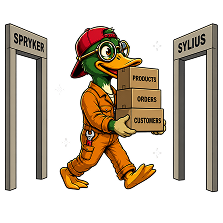
The wild ducks. We had been the renegades of the enterprise digital commerce herd from the start.
We focused on solution maintenance (the dirty job of software development) while most of the market focused on new implementations.
As the wild ducks, we barely fit in the herd. We raised uncomfortable questions and challenged the platform operators’ strategies. But we also joined core product development on some of the top Symfony-based platforms and fixed pressing issues during their flagship rollouts.
The reCommerce project has been implemented in 6 months (May — Oct 2025) in the following stages:
– Design of Functional Requirements
– Systems Architecture and re-platforming the code delivery process development
– Implementation of BE and FE (including redesign of the website home page)
– MVP Testing with customer business units, Fixes, and Adjustments
– Staged production systems migration and domains switchover
– Rapidly aligned with Sylius leadership and engineers on the real-life capabilities of the Sylius Plus modules in architecting the final production system.
– Ran preliminary stress tests and planned key reCommerce scenarios (including launching the bare-bone go-live with minimum custom code migrations scenario)
– Combined AXON21’s unique capabilities in a resonance:
1. Applied top-tier Symfony-based architecture, engineering, and full-stack delivery expertise.
2. Leveraged proprietary AXON21 AI Delivery Platform for multiplying the Team’s productivity 3 times.
3. As the Commerce Stack Operator (vs Agency), we fully owned the project from the start.
– Focused on ensuring reCommerce long-term success at functional, performance, and cost levels (including clean architecture of the solution for long-term maintenance and evolution vs. a one-off rollout at minimal cost of the implementation team).
– From the start, secured full control of all technical aspects and decisions driving the project (this allowed us to make key decisions internally without risking stalling and loss of momentum, as in the case when the client’s approval is required at key milestones).
– Maintained direct proactive communications between AXON21 and the client on two levels (technical and business leadership), ensuring continuous buy-in and rapid adjustments
1. Our unique business model as the Commerce Stack Operator that involves continuous maintenance and evolution of the deployed solution supports the true role of the platform operator — continuous platform refactoring. However, economic incentives favored new implementations over long-term maintenance and the reduction of technical debt, which grew heavier over time. Until it became unsustainable in 2025-2026.
The traditional implementation-centric model is now under significant pressure.
2. We have successfully applied AI to a rapid, effective enterprise solution migration, on time and on budget, against the hard deadline. More importantly, in this case, we solved the fundamental legacy stack attachment barrier, the attachment to the implementation’s code glue that represented the insurmountable sunk cost that no CTO has been ready to spend in case of replatforming. This sunk cost has prevented many organizations from pursuing replatforming initiatives for years.
We’ve scraped it off and rebuilt it on a new platform, as part of a fresh full-stack solution, without losing custom implementations. This is an undervalued leverage of AI — making business free from the chains of legacy platforms.
The real open question to the owners of enterprise digital commerce projects is:
How do you upgrade your commerce stack to the cutting edge in the next 6 months while preserving business logic and eliminating platform licensing costs?
If you read this in 2026, let the message sink in. Are you still burning your operating budget on the legacy project, while feeding your technical debt and attachment to it? If so, why?
Today, just before this paragraph was written, on a weekly call, our client, after getting updated on AXON21’s Managed Agentic Solution, delivering AI functionality, said:
«I’m very happy to see this feature in real life. It has been a dream for a long time. We’re flying to the moon!»